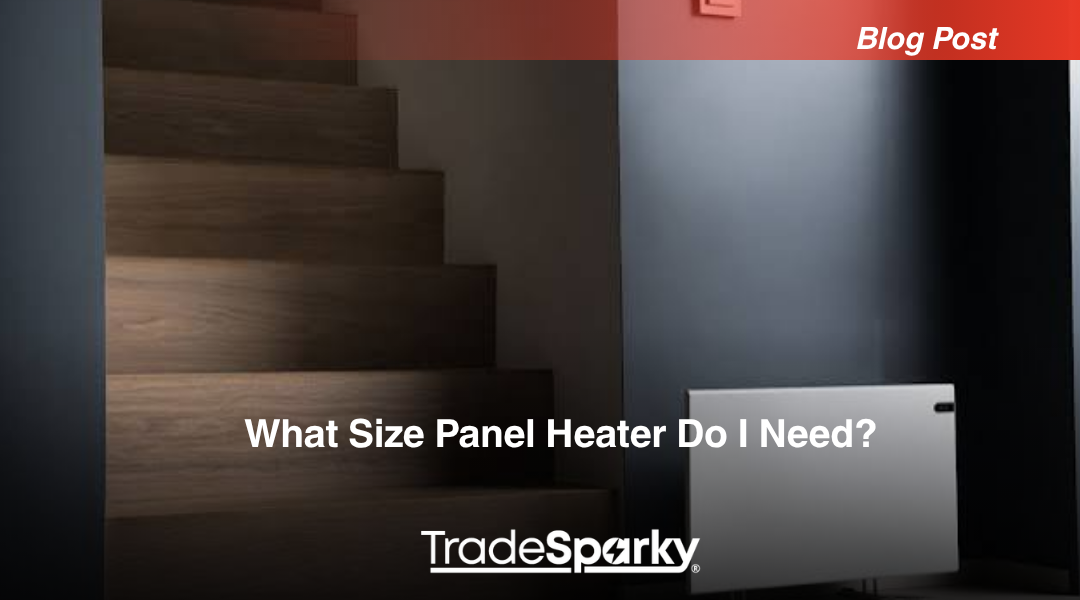
Choosing the right size panel heater is important if you want a room to warm up effectively without installing more heating capacity than you need.
Panel heaters that are too small may struggle to reach the desired temperature, while an unnecessarily powerful model may be larger and more expensive than required.
Panel heater size is normally expressed in watts or kilowatts, but choosing the correct output involves more than simply looking at the floor area of the room.
How Is Panel Heater Size Measured?
The output of a panel heater is stated in watts. For example, common sizes include 500W, 750W, 1kW, 1.5kW and 2kW.
Higher wattage means the heater can produce more heat while operating. As a rough starting point, a reasonably insulated room with a standard ceiling height may require approximately 70W to 100W per square metre when the panel heater is being used as the primary heat source.
For example, a 10m² room might therefore require somewhere around 700W to 1kW of heating output.
This is only an initial estimate. The actual heat requirement can vary considerably according to the property.
If you want to understand the basic heating process first, our guide to what a panel heater is and how it works explains how these heaters use convection to warm a room.
Does Insulation Affect Panel Heater Size?
Yes. Insulation has a major influence on how quickly heat escapes from a room.
A modern, well-insulated room may need less heating output than an older room of exactly the same dimensions. Properties with solid walls, poor loft insulation or significant draughts can lose heat considerably faster.
This is why two bedrooms measuring 12m² may require different heater outputs despite having identical floor areas.
Improving insulation can reduce the amount of heat required to maintain a comfortable temperature and may also reduce how frequently the heater needs to operate.
What Other Factors Affect the Wattage Required?
Several characteristics of the room can increase or reduce its heating requirement.
Ceiling height is important because taller rooms contain a greater volume of air. A simple square-metre calculation based only on floor area may underestimate the heat required in a room with unusually high ceilings.
External walls can increase heat loss, particularly in corner rooms with two or more walls exposed to outside temperatures.
Windows and glazing also matter. Large areas of glazing generally lose more heat than insulated walls, although modern double or triple glazing can significantly reduce this effect.
You should also consider the room's intended temperature. A living room that needs to remain comfortably warm for several hours may have different requirements from a hallway or spare room that is only heated occasionally.
For rooms with unusual construction, extensive glazing or particularly poor insulation, a proper heat-loss calculation is preferable to relying solely on a simple watts-per-square-metre estimate.
Is a Bigger Panel Heater Better?
Not necessarily. Choosing a much larger heater does not automatically make the heating system more economical. Once the desired temperature is reached, a thermostatically controlled heater should cycle on and off to maintain it.
However, choosing a heater that is significantly undersized can be problematic. It may remain on for long periods while still failing to bring the room up to the required temperature.
This can affect both comfort and electricity consumption. Our guide to whether panel heaters are expensive to run explains how wattage, thermostats and operating time affect the amount of electricity a heater uses.
Can You Use Two Panel Heaters in One Room?
Yes. In a larger or unusually shaped room, two smaller heaters can sometimes provide even heat distribution than one large heater positioned at one end.
This can be useful in long rooms, open-plan spaces or areas where furniture and room layout restrict suitable mounting positions.
The important figure is the combined heating output. If a room requires approximately 2kW, for example, two suitably positioned 1kW heaters may provide the required total output.
Should You Round the Wattage Up or Down?
If your calculated requirement falls between two available heater sizes, it is generally better to select the next appropriate output rather than choosing a model that is clearly underpowered.
The thermostat can control a correctly sized heater once the room reaches temperature, whereas an undersized heater cannot produce additional output when more heat is required.
Output is not the only consideration either. Controls, installation methods and heating characteristics can also influence which product is most suitable. Our guide comparing panel heaters vs electric radiators explains how the two heating types differ when deciding what to install.
Finding the Right Panel Heater
Start with the room's floor area, then consider insulation, ceiling height, glazing and the number of external walls before choosing an output.
For standard rooms, the watts-per-square-metre approach provides a useful estimate, while more challenging spaces may benefit from a detailed heat-loss calculation.
Once you have established the output required, compare our range of panel heaters across different wattages, sizes and control options to find a suitable heater for your room.




















































 Cable & Cable Installations
 Lighting & Lamps
 Wiring Accessories
 Cable Accessories
 Power Distribution
 Heat & Vent
 Energy Controls
 Fire & Security
 Tools & Fixings
 Test Equipment
 Site Equipment & Lighting
 EV Charging
 Solar
Solar


.png)