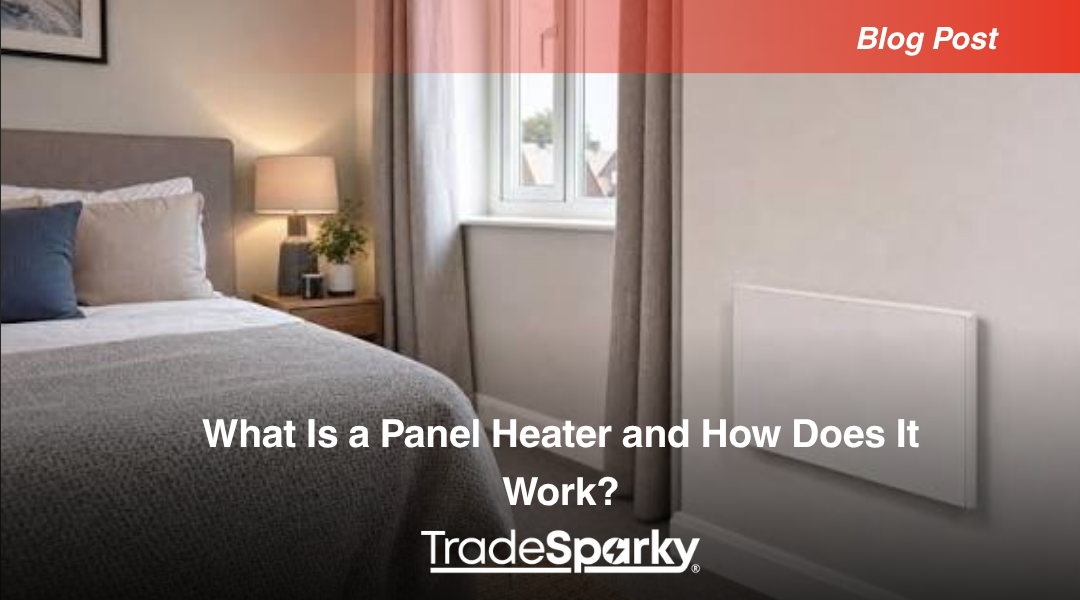
Panel heaters provide a simple way to heat individual rooms using electricity, without requiring a boiler, pipework or a traditional wet central heating system. Their slim design makes them particularly suitable for homes, offices and other spaces where straightforward room-by-room heating is required.
But how does a panel heater actually produce heat and when does this type of electric heating make sense?
What Is a Panel Heater?
A panel heater is a direct electric heater designed to warm an individual room. Most models have a slim rectangular design and are installed on a wall, although some can also be used with feet for freestanding installation.
Unlike storage heaters, panel heaters do not store heat to release later. Electricity is used when heating is required, allowing the heater to respond relatively quickly when switched on.
This makes them particularly useful where you want control over the temperature of individual rooms rather than heating an entire property through one central system.
How Does a Panel Heater Work?
Most conventional panel heaters primarily use convection to distribute warmth around a room.
Electricity powers a heating element inside the unit, which warms the air immediately around the heater. As this air becomes warmer it rises, allowing cooler air to move towards the heater where it can also be warmed. This process creates natural circulation within the room and gradually raises the overall temperature.
Some designs may also provide an element of radiant warmth from the front surface, but convection is generally the main way traditional panel heaters distribute heat.
Because they are direct-acting heaters, they begin producing warmth when required rather than charging in advance.
How Are Panel Heaters Controlled?
Modern panel heaters can offer considerably more control than simply switching the heater on and off.
A thermostat allows you to choose the required room temperature. Once that temperature has been reached, the heater can reduce or stop drawing power before switching back on when additional heat is needed.
Depending on the model, additional controls may include:
These features allow heating to be targeted around when individual rooms are actually occupied.
If energy cost is one of your main concerns, our guide to whether panel heaters are expensive to run explains how wattage, electricity prices and heating controls affect running costs.
Where Do Panel Heaters Work Best?
Panel heaters can be useful where quick and straightforward electric room heating is required.
They are commonly considered for bedrooms, home offices, conservatories, smaller flats and properties where extending an existing wet heating system would be impractical. They can also provide supplementary heating in individual rooms that need additional warmth.
Because each heater can usually be controlled separately, there is no need to heat unused rooms simply because one part of the property feels cold.
However, direct electric heating can become expensive when used continuously as the main source of heat throughout a poorly insulated property. Good insulation and sensible temperature control can therefore make a significant difference to how effectively a panel heating system operates.
What Wattage Panel Heater Do You Need?
Panel heaters are available in different outputs, usually stated in watts or kilowatts.
A small room will generally require less heating output than a large room, but floor area is not the only consideration. Insulation, ceiling height, glazing, external walls and the desired indoor temperature can all affect heat requirements.
Choosing the correct output is important because a heater that is too small may struggle to bring the room up to temperature, while unnecessarily high output may not be the most appropriate choice either.
Our guide to what size panel heater you need looks at these factors in more detail and explains how to estimate a suitable wattage for your room.
Are Panel Heaters the Same as Storage Heaters?
No. Although both use electricity, they operate differently.
Storage heaters are designed to store thermal energy, traditionally using cheaper off-peak electricity, before releasing that heat gradually later. Panel heaters instead use electricity at the time you want heat.
This makes panel heaters considerably more responsive and straightforward to control on demand, but electricity costs and how long the heaters are operated need to be considered when deciding whether they are suitable for a particular property.
Choosing a Panel Heater
Before buying, consider the size of the room, required wattage, available controls and how frequently the heater will be used.
Features such as accurate thermostats, programmable schedules and smart controls can also make managing individual rooms easier.
Once you know what your room requires, explore our range of electric heating solutions to compare different outputs, sizes and control options for your installation.








































 Cable & Cable Installations
 Lighting & Lamps
 Wiring Accessories
 Cable Accessories
 Power Distribution
 Heat & Vent
 Energy Controls
 Fire & Security
 Tools & Fixings
 Test Equipment
 Site Equipment & Lighting
 EV Charging
 Solar
Solar


.png)