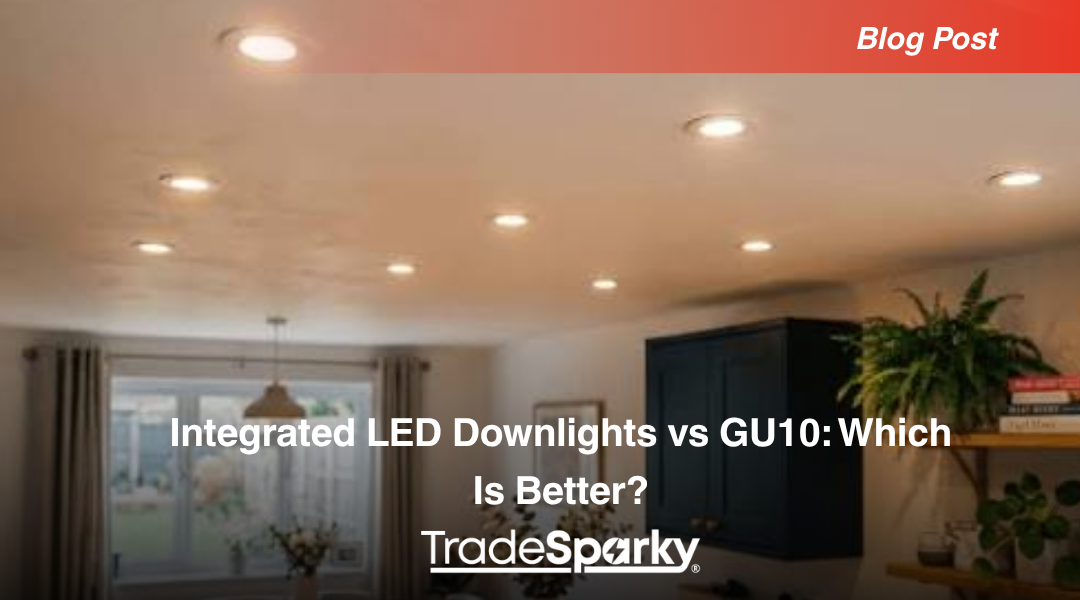
Integrated LED Downlights vs GU10: Which Is Better?
When choosing new ceiling lighting, one of the main decisions is whether to use an integrated LED downlight or a fitting that accepts a replaceable GU10 LED lamp. Both provide efficient LED lighting, but the way they are designed can make a significant difference to maintenance, flexibility and the overall installation.
There is no option that is automatically better for every room. Understanding the differences between the two will help you choose the most suitable LED downlights for your property and avoid discovering later that the fitting does not offer the flexibility you expected.
What Is An Integrated LED Downlight?
An integrated LED downlight has the LED light source built into the fitting rather than using a conventional replaceable lamp.
The LEDs, optics and driver are designed to work together as part of the complete unit. This can allow manufacturers to produce compact fittings with carefully controlled light output, beam angles and thermal management.
Because the light source forms part of the fitting, however, it will not usually be as simple as twisting out a lamp when the LED eventually reaches the end of its usable life. Depending on the design, the LED module or complete fitting may need replacing.
What Is A GU10 Downlight?
A GU10 downlight is essentially the fitting that holds a separate GU10 lamp.
The GU10 lamp contains its own LED light source and electronics and is inserted into the lamp holder using the familiar push-and-twist connection.
One of the biggest advantages of this arrangement is replaceability. If a lamp fails or you want to change the light output, colour temperature or beam angle, you can normally replace the GU10 without changing the ceiling fitting itself.
Which Is Easier To Maintain?
GU10 downlights generally have the advantage when it comes to straightforward maintenance.
If one lamp reaches the end of its life, you can replace that individual lamp. This can be particularly useful in installations containing a large number of downlights because you are not necessarily replacing an entire fitting whenever a light source needs attention.
Integrated LED fittings can still provide very long service lives, but what happens when the light source or driver eventually fails depends on the construction of the product.
It is therefore worth checking the manufacturer's rated lifetime and warranty when comparing integrated fittings.
Which Gives You More Flexibility?
GU10 fittings usually provide greater flexibility after installation.
Different GU10 lamps are available with varying lumen outputs, colour temperatures, beam angles and dimming capabilities. You can therefore alter the characteristics of the lighting later without necessarily changing the downlight itself.
This can be useful if you decide that a warm white lamp would suit a living room better than cool white, or if you want to change the beam angle during a future refurbishment.
Integrated fittings are generally more fixed in specification, although some modern models include selectable colour temperatures or other adjustable settings.
Are Integrated LED Downlights More Compact?
They can be.
Removing the conventional GU10 lamp holder allows some integrated fittings to be designed with a shallower overall depth, which may be useful where ceiling void space is restricted.
This does not mean every integrated fitting is shallower than every GU10 fitting, so dimensions should always be checked before purchase.
Ceiling depth is only one part of planning an installation. Our guide to how many LED downlights you need also explains how spacing, lumen output and beam angle influence the finished lighting scheme.
What About Dimming?
Both integrated LED and GU10 systems can offer dimming, but compatibility needs to be checked carefully.
A GU10 lamp must itself be dimmable and should be used with a suitable LED-compatible dimmer. Mixing different lamp models on the same dimming circuit can also lead to inconsistent performance because their electronic drivers may behave differently.
Integrated fittings can likewise be offered in dimmable and non-dimmable versions, so you should never assume a fitting will work correctly with an existing dimmer.
Which Is Better For Bathrooms And Fire-Rated Ceilings?
Neither design is automatically suitable simply because it uses LED technology.
For bathrooms, the fitting must have an appropriate IP rating for its intended location. Our guide to bathroom LED downlights and IP ratings explains the additional considerations involved.
Likewise, where a ceiling needs to maintain a particular level of fire resistance, you may need a suitable fire rated LED downlight rather than an ordinary fitting.
Integrated LED Or GU10: Which Should You Choose?
Choose GU10 if replaceable lamps and the ability to change colour temperature, output or beam characteristics later are priorities.
Integrated LED fittings can be an excellent choice where you want a purpose-designed unit, compact dimensions or a particular combination of performance features.
For many installations, the decision ultimately comes down to whether you value long-term lamp flexibility or prefer a complete integrated fitting. Compare the specification of the individual products rather than assuming one technology is universally superior.



















































 Cable & Cable Installations
 Lighting & Lamps
 Wiring Accessories
 Cable Accessories
 Power Distribution
 Heat & Vent
 Energy Controls
 Fire & Security
 Tools & Fixings
 Test Equipment
 Site Equipment & Lighting
 EV Charging
 Solar
Solar


.png)