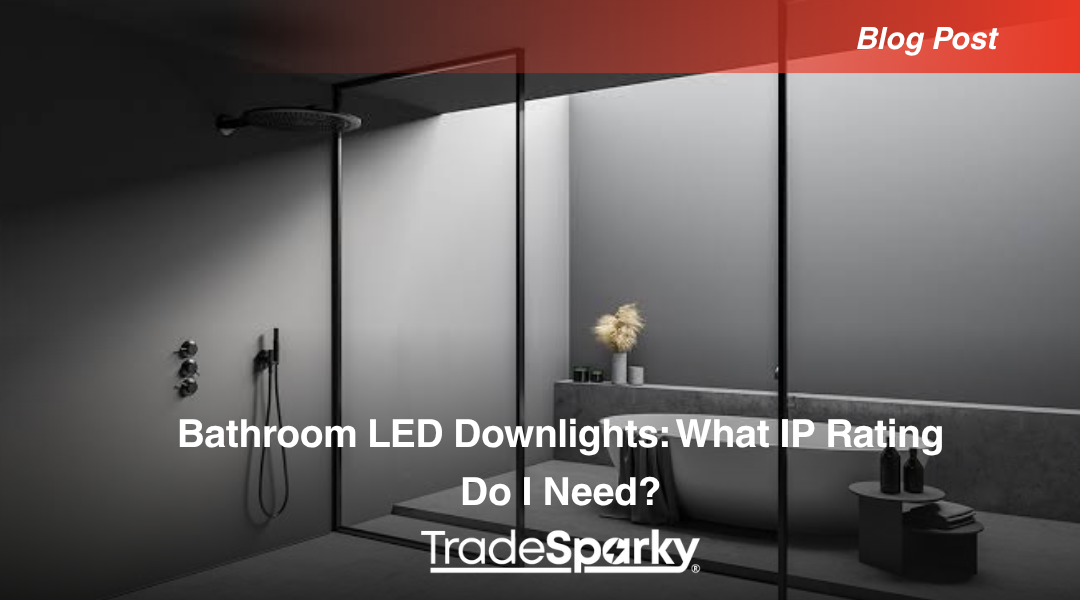
Choosing lighting for a bathroom involves an extra consideration that does not normally apply in bedrooms, hallways or living rooms: protection against water. Bathrooms are divided into electrical zones according to how close a fitting is to a bath or shower, and the position of a downlight can determine the minimum level of water protection required.
Understanding IP ratings therefore makes it much easier to choose suitable LED downlights for a bathroom without simply assuming that every fitting labelled "bathroom suitable" can be installed anywhere in the room.
What Does An IP Rating Mean?
IP stands for Ingress Protection. The two numbers following the letters describe how well an electrical enclosure protects against solids and water.
For example, an IP44 fitting has:
-
A first digit of 4, indicating protection against solid objects larger than 1mm
-
A second digit of 4, indicating protection against splashing water
An IP65 fitting provides a higher level of protection, with complete protection against dust and protection against water jets.
For bathroom electrical zones, it is primarily the second number that matters. This is why electrical regulations often refer to ratings such as IPX4, where the "X" simply means the solid-particle rating is not being specified for that particular requirement.
What Are Bathroom Electrical Zones?
Bathrooms containing a bath or shower are divided into Zones 0, 1 and 2.
Zone 0 is essentially the inside of the bath or shower tray itself. Electrical equipment installed here requires particularly stringent protection and must be at least IPX7, meaning protection against temporary immersion in water.
Zone 1 is the area directly above the bath or shower up to 2.25m from the finished floor level in a conventional installation. Equipment installed within this zone must normally provide at least IPX4 protection.
Zone 2 extends 600mm horizontally beyond the boundary of Zone 1. Equipment here must also normally be at least IPX4.
Where equipment may be exposed to water jets rather than ordinary splashing, protection increases to at least IPX5.
Walk-in showers and showers without a conventional tray can produce slightly different zone boundaries, so the exact layout should be assessed rather than relying on a generic diagram.
Is IP44 Suitable For Bathroom Downlights?
An IP44 downlight can meet the minimum water-ingress requirement for Zones 1 and 2 where only splashing water is expected.
That does not necessarily mean IP44 is always the most practical choice, however.
Many modern bathroom downlights are IP65 from below. This provides additional resistance to water and makes one specification suitable across a wider range of bathroom positions.
For this reason, IP65 fittings have become a popular choice for bathroom ceilings, particularly around showers.
Do Bathroom Downlights Need To Be IP65?
Not automatically.
The minimum requirement in Zones 1 and 2 is generally IPX4 unless water jets are likely, in which case IPX5 is required.
An IP65 fitting exceeds the IPX4 requirement for splashing water, but that does not mean every light in every bathroom legally needs an IP65 rating.
Outside the defined zones, Section 701 does not impose the same specific additional IP rating. The fitting should still be appropriate for its environment, particularly where condensation and moisture are likely.
Can I Put LED Downlights Above A Shower?
Yes, suitable fixed lighting can be installed above a bath or shower, provided it meets the requirements for the zone in which it is positioned and is installed according to the manufacturer's instructions.
For a typical ceiling within Zone 1, the fitting should be at least IPX4, or IPX5 where water jets may be encountered.
In practice, an IP65 bathroom downlight is therefore a common choice above showers.
Does A Bathroom Downlight Also Need To Be Fire Rated?
Possibly, but the IP rating and fire rating perform completely different jobs.
The IP rating deals with protection against water and solid objects. A fire rating relates to maintaining the fire resistance of a ceiling after a hole has been cut for the recessed fitting.
Our guide to fire rated LED downlights explains when this becomes an important consideration.
You should therefore check both characteristics independently rather than assuming an IP65 fitting is automatically fire rated.
What Else Should You Consider?
Once the correct IP rating has been established, you can consider the normal lighting characteristics such as lumen output, colour temperature, beam angle and dimming.
Bathroom lighting often benefits from good colour rendering around mirrors and sufficient output for shaving, applying make-up and other tasks, while warmer or dimmable lighting can make the room more relaxing.
Your choice between integrated LED downlights and GU10 fittings can also affect future lamp replacement and flexibility.
Ultimately, the best bathroom downlight is not simply the fitting with the highest IP number. It is one with the appropriate ingress protection for its location alongside the correct electrical, fire and lighting performance for the installation.














































 Cable & Cable Installations
 Lighting & Lamps
 Wiring Accessories
 Cable Accessories
 Power Distribution
 Heat & Vent
 Energy Controls
 Fire & Security
 Tools & Fixings
 Test Equipment
 Site Equipment & Lighting
 EV Charging
 Solar
Solar


.png)