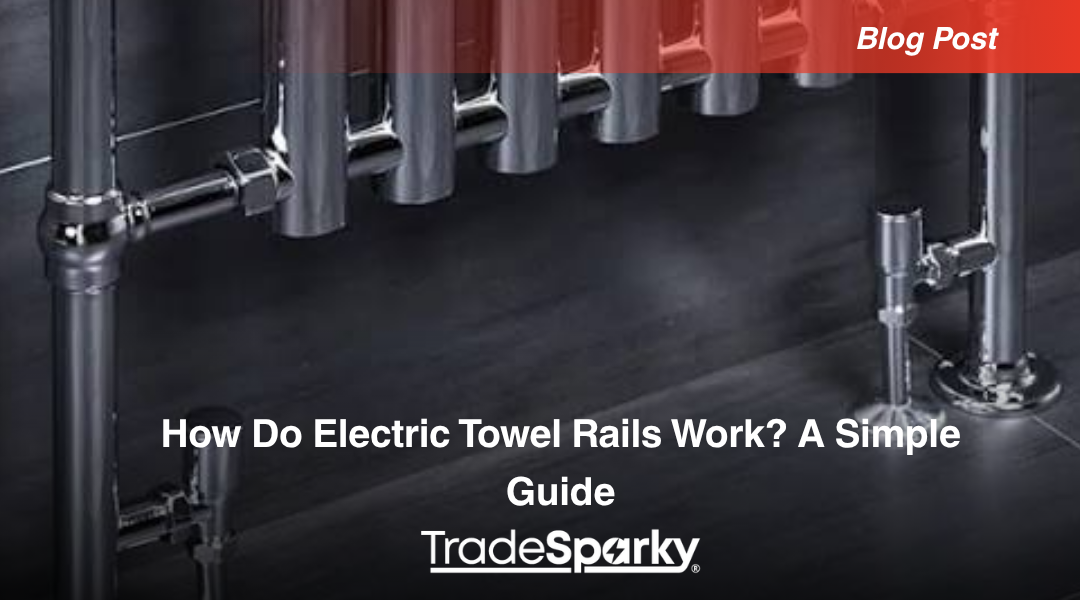
Electric towel rails provide a convenient way to keep towels warm and dry without relying on a property’s central heating system.
They are particularly useful in bathrooms and en-suites because they can operate independently throughout the year, including during warmer months when switching on the main heating system would make little sense.
Although different designs are available, the basic principle is straightforward: electricity is converted into heat and transferred through the towel rail, warming both the rail itself and the towels placed over it.
What Is an Electric Towel Rail?
An electric towel rail is a wall-mounted heating appliance designed primarily to warm and dry towels while also releasing some heat into the surrounding room.
Unlike a traditional hydronic towel radiator connected to a boiler and central heating pipework, an electric model has its own electrical heating element. This means it can operate independently whenever heat is required.
That flexibility makes an electric towel rail particularly useful for bathrooms, en-suites, cloakrooms and other spaces where towel warming may be required even when the rest of the heating system is switched off.
How Does an Electric Towel Rail Produce Heat?
Electric towel rails use resistance heating. When electricity passes through the heating element, electrical energy is converted into heat.
In many models, the rail is filled with a heat-transfer liquid. An electric element heats this fluid, which then circulates heat through the body of the towel rail and helps create an even surface temperature.
Other designs use different heating arrangements, but the purpose remains the same: transferring electrical heat across the rail so towels can absorb that warmth.
The heated rail also releases energy into the surrounding room through a combination of convection and radiant heat.
Do Electric Towel Rails Heat the Bathroom?
They can, but this depends heavily on the output of the towel rail.
Some lower-wattage models are designed mainly for warming and drying towels. They will release heat into the bathroom, but they may not provide enough output to act as the room’s primary heat source.
Higher-output electric towel rails can make a more significant contribution to space heating, particularly in smaller bathrooms and en-suites.
This is why wattage matters. A 60W towel rail designed primarily for towel drying serves a very different purpose from a 500W or 600W model intended to provide considerably more room heating.
We will cover this in more detail in our guide to what size electric towel rail you need.
Why Are Electric Towel Rails Useful in Summer?
One of their biggest advantages is independence from central heating.
With a conventional towel radiator connected only to a boiler, obtaining warm towels during summer may require operating part of the central heating system. An electric towel rail can instead be switched on by itself.
That means you can warm towels after a shower without heating radiators throughout the rest of the property.
Models with timers make this even more convenient because the rail can be programmed to operate around normal bathroom routines rather than remaining switched on all day.
What Do Thermostats and Timers Do?
Controls vary considerably between electric towel rails.
Basic models may simply switch on and off, while more advanced products can include electronic thermostats, timers, boost functions, weekly programming, open-window detection and Wi-Fi control.
A thermostat allows the appliance to regulate its heating rather than continuously operating at maximum output. Timers and schedules can restrict operation to periods when warm towels or bathroom heating are actually required.
Some modern towel rails also offer short boost programmes, which can be particularly useful before a shower or bath.
Are Electric Towel Rails Always Liquid Filled?
No. Electric towel rails are available using different heating technologies.
Liquid-filled models use an electrical element to warm a heat-transfer fluid inside the rail. This helps distribute heat through the body of the appliance and can provide steady, even warmth.
Other electric towel warmers use heating elements without relying on the same liquid-filled arrangement.
The best option depends on whether the priority is simply drying towels, providing additional bathroom warmth or using the towel rail as a more substantial room heater.
Can You Leave an Electric Towel Rail on All the Time?
Whether this is appropriate depends on the specific model and manufacturer instructions, but there is generally little reason to heat towels continuously if the warmth is not required.
Using a timer or programmable controller allows the rail to operate around normal bathroom use instead.
This can reduce unnecessary electricity consumption while still ensuring towels are warm when you actually want them.
Choosing the Right Electric Towel Rail
Before choosing an electric towel rail, think about what you actually expect it to do.
If the main objective is drying and warming towels, a relatively modest output may be sufficient. If you also expect it to heat the bathroom, room size, insulation, glazing and heat loss become much more important.
Controls are worth considering too. A basic towel warmer may be perfectly suitable for occasional use, while programmable thermostats and smart controls can provide greater flexibility where the rail is used every day.
Understanding how electric towel rails work makes it much easier to compare the different wattages, styles and control options available and choose a model that suits both your bathroom and the way you intend to use it.

















































 Cable & Cable Installations
 Lighting & Lamps
 Wiring Accessories
 Cable Accessories
 Power Distribution
 Heat & Vent
 Energy Controls
 Fire & Security
 Tools & Fixings
 Test Equipment
 Site Equipment & Lighting
 EV Charging
 Solar
Solar


.png)