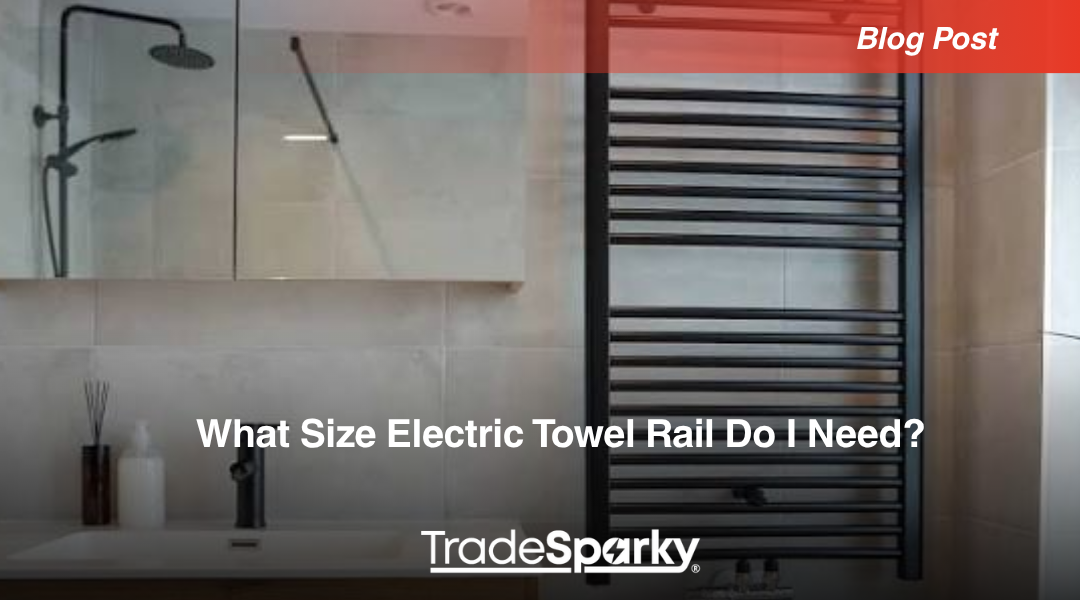
Choosing the right electric towel rail is not simply a case of finding one that fits the available wall space. Physical dimensions certainly matter, but the wattage of the rail and what you expect it to do are just as important.
A compact electric towel rail may be perfectly adequate for warming and drying towels, while a larger higher-output model may be needed if you also want it to contribute meaningful heat to the bathroom.
Start With What You Want the Towel Rail to Do
The first question is whether the electric towel rail will primarily be used for towels or whether you also expect it to heat the room.
These are two different requirements.
A relatively low-output rail can provide enough warmth to help dry damp towels and make them more comfortable to use. It may also take some of the chill out of a small bathroom, but that does not necessarily mean it can replace the room's main heating system.
If the towel rail is intended to provide substantial bathroom heating, its output needs to be considered against the room's actual heat requirement.
You can compare different sizes, wattages and control options across our range of electric towel rail options.
Does a Bigger Towel Rail Produce More Heat?
Generally, larger towel rails tend to have greater potential heat output because they have more heated surface area and are often fitted with higher-powered elements.
However, physical size and wattage should not be treated as the same thing.
Two rails of similar dimensions can have different electrical outputs, so always check the manufacturer's stated wattage rather than assuming that the tallest or widest model will automatically provide the most heat.
For electric models, you may encounter outputs ranging from relatively modest wattages intended mainly for towel warming through to several hundred watts for larger bathroom heating products.
What Wattage Electric Towel Rail Do I Need?
There is no single wattage that suits every bathroom.
If the rail is mainly being used to warm towels, the required power may be relatively low. If it is expected to heat the room as well, you need to consider how much heat that particular bathroom loses.
Room dimensions are an obvious starting point, but several other factors affect the amount of heating required.
A small modern bathroom with good insulation and double glazing may retain warmth very effectively. An older bathroom of the same size with an external wall, large window and poorer insulation could require considerably more heat.
Ceiling height also matters because a taller room contains a greater volume of air to heat.
Measure the Available Wall Space
Once you understand the heating requirement, consider where the towel rail will actually be fitted.
Measure both the available height and width, remembering that the overall installation may require additional clearance around the appliance. You should also consider how far the rail projects from the wall and whether towels can be placed over it without obstructing doors, cupboards or other bathroom fittings.
A taller rail can provide more hanging space without necessarily occupying much more wall width, which can make vertical ladder-style designs particularly useful in smaller bathrooms.
Always follow the manufacturer's installation dimensions and clearance requirements rather than choosing a rail that only just fits the available space.
Remember That Towels Affect Heat Output
A towel rail covered with thick towels cannot transfer heat into the room as freely as an uncovered heating appliance.
That is not a problem when its main purpose is warming towels, but it becomes more important if you are relying on the rail to heat the bathroom itself.
If substantial space heating is required, make sure the specified output is adequate for the room rather than assuming all of the rail's rated heat will always be available while it is covered.
What About Small En-Suites?
Compact en-suites often need less heating than large family bathrooms, which can make smaller electric towel rails particularly practical.
Their independent operation is also useful because the rail can provide warm towels without requiring the central heating to be switched on throughout the property.
In a larger bathroom, you may prefer a higher-output model or use the towel rail alongside another suitable bathroom heater if the calculated heat requirement exceeds what the rail can comfortably provide.
Controls Matter as Well as Wattage
Once you have narrowed down the appropriate output, compare the controls available.
Thermostatic control can help regulate temperature, while timers and programmed schedules allow the rail to operate around normal bathroom use rather than remaining switched on unnecessarily.
Some electric towel rails also provide boost functions or smart controls, giving you more flexibility over when maximum heat is required.
Choosing the Right Size
The best electric towel rail is one that physically fits the available space while providing enough output for its intended purpose.
Start by deciding whether you simply want warm towels or meaningful room heating, then consider the bathroom dimensions, insulation, glazing, external walls and available mounting space.
Once those requirements are clear, comparing wattages and dimensions becomes much easier and you are far less likely to end up with a towel rail that is either unnecessarily large or unable to provide the warmth you expected.



















































 Cable & Cable Installations
 Lighting & Lamps
 Wiring Accessories
 Cable Accessories
 Power Distribution
 Heat & Vent
 Energy Controls
 Fire & Security
 Tools & Fixings
 Test Equipment
 Site Equipment & Lighting
 EV Charging
 Solar
Solar


.png)