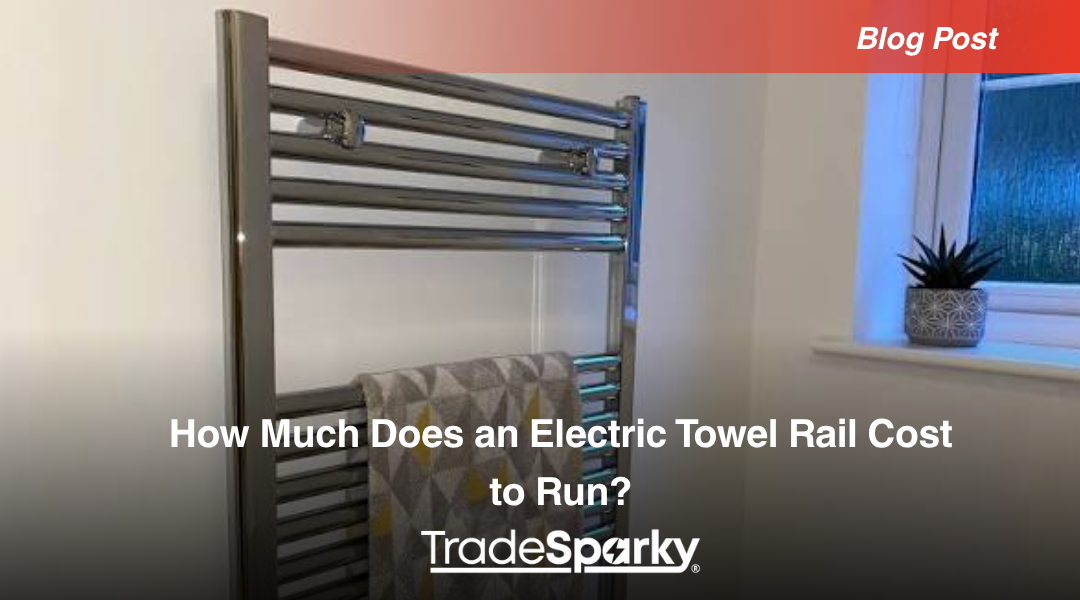
Electric towel rails are convenient because they can warm towels and provide useful bathroom heat without switching on the entire central heating system.
Before installing one, however, it is sensible to understand how much electricity it may use and what that means for your energy bill.
The running cost of an electric towel rail is mainly determined by its wattage, how long it operates and the price you pay for electricity. Fortunately, estimating the cost is straightforward.
How Is Electric Towel Rail Running Cost Calculated?
Electricity is charged in kilowatt hours, usually shown as kWh on your energy bill.
To estimate the cost of running an electric towel rail, first convert its wattage into kilowatts by dividing by 1,000. You can then multiply that figure by your electricity unit rate and the number of hours the towel rail operates.
The calculation is:
Wattage ÷ 1,000 × electricity price per kWh × hours used
For example, a 500W towel rail is a 0.5kW appliance. If electricity costs approximately 26p per kWh and the rail operates continuously for one hour, the maximum electricity cost would be around 13p.
Your actual tariff should always be used when working out your own running costs.
How Much Do Different Wattages Cost?
Lower-powered towel rails can cost relatively little to operate for short periods.
Using an electricity price of approximately 26p per kWh as an example, a 100W towel rail would cost around 2.6p per hour if operating continuously. A 150W model would use roughly 3.9p per hour, while a 300W rail would cost around 7.8p.
A 500W towel rail would cost approximately 13p per hour and a 600W model around 15.6p.
These figures assume continuous operation at full rated power. They are useful for comparisons, but they do not necessarily represent what the appliance will consume throughout an entire day.
Does an Electric Towel Rail Use Full Power Constantly?
Not always.
Some basic towel warmers may operate whenever they are switched on, while more advanced models use thermostatic controls to regulate their heat output.
Once the required temperature has been reached, a thermostatically controlled electric towel rail may cycle its heating element rather than continuously drawing its maximum rated power.
Actual consumption therefore depends on the type of control, room temperature, heat loss and how the towel rail is being used.
When comparing electric towel rail options, it is worth considering the available controls as well as simply comparing wattage.
Does a Higher Wattage Mean Higher Running Costs?
A higher-powered towel rail will consume more electricity while operating at full output.
However, that does not automatically mean the lowest wattage model is the best choice.
If you only want to warm and dry towels, a relatively low-output rail may be perfectly adequate. If you expect the appliance to provide meaningful bathroom heating as well, choosing too little output could leave the room uncomfortable.
The aim is to select a towel rail that suits the job rather than simply choosing the model with the lowest power rating.
Our guide to what size electric towel rail you need looks at this in more detail.
Can Timers Reduce Running Costs?
Timers can be particularly useful because most people do not need warm towels 24 hours a day.
A towel rail could instead be programmed to operate before the bathroom is normally used in the morning and again later in the evening.
Some models include built-in programming, boost modes or smart controls, while others can be paired with an appropriate external controller where the installation permits.
Using the rail only when required can substantially reduce electricity consumption compared with leaving it operating continuously.
Is It Cheaper Than Turning on Central Heating?
This depends on what you are trying to achieve.
If you only want warm towels or some additional heat in one bathroom, operating a small electric towel rail may make more sense than heating an entire property unnecessarily.
That does not mean electricity is cheaper per unit than gas or other heating fuels. The potential advantage comes from heating a specific area rather than operating a much larger heating system solely for one room.
Are Electric Towel Rails Expensive to Run?
Electric towel rails do not have to be particularly expensive to operate when they are correctly sized and used sensibly.
A lower-wattage rail running for a few hours each day can consume relatively little electricity, while a high-output model left running continuously will naturally cost more.
The most useful approach is to check the wattage, apply your own electricity tariff and consider how many hours the rail genuinely needs to operate.
Choosing appropriate controls and using timers where possible can then help provide warm, dry towels without using electricity unnecessarily.














































 Cable & Cable Installations
 Lighting & Lamps
 Wiring Accessories
 Cable Accessories
 Power Distribution
 Heat & Vent
 Energy Controls
 Fire & Security
 Tools & Fixings
 Test Equipment
 Site Equipment & Lighting
 EV Charging
 Solar
Solar

.png)