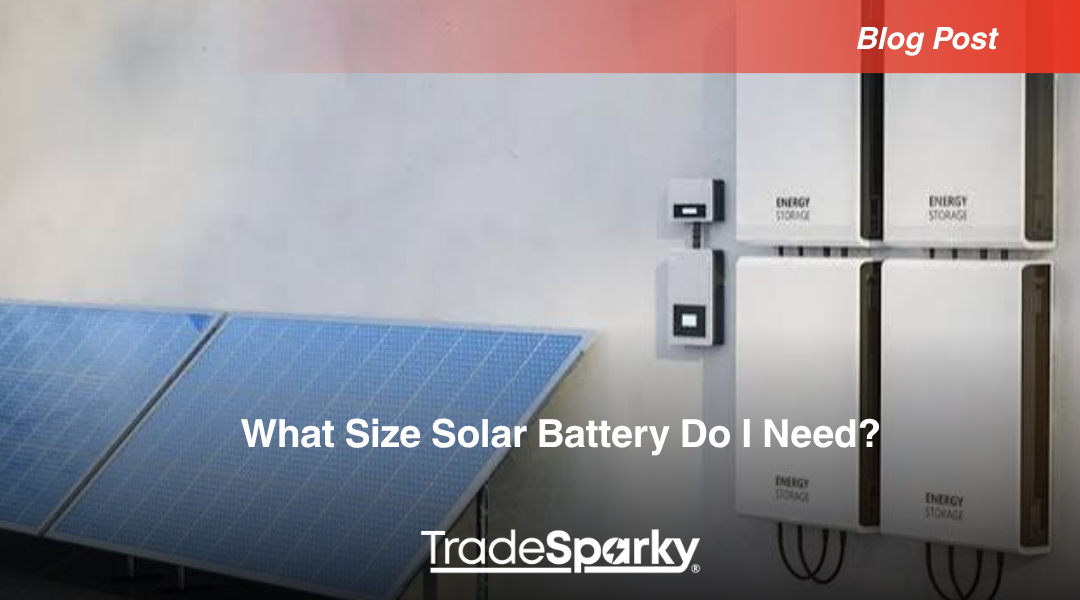
Choosing the right solar battery size is one of the most important parts of planning a home battery storage system.
Too little capacity may mean you regularly run out of stored energy, while an oversized battery could leave you paying for storage that you rarely use.
There is no single battery size that suits every household. The right capacity depends on how much electricity you use, when you use it, how much electricity your solar panels generate and whether you also intend to charge the battery from the grid.
How Is Solar Battery Size Measured?
Solar battery capacity is usually measured in kilowatt-hours or kWh.
A 5kWh battery can theoretically store around 5kWh of electrical energy, while a 10kWh battery provides around twice that storage capacity. However, the usable capacity may be slightly lower than the headline figure depending on the battery design and permitted depth of discharge.
Battery capacity should not be confused with power output, which is measured in kilowatts or kW. Capacity determines how much energy can be stored, while power output determines how much electricity the battery can supply at one time.
If you want a broader introduction before looking at sizing, our guide to what a solar battery is and how battery storage works explains the basics.
Start With Your Electricity Consumption
Your household electricity consumption is one of the best places to start when estimating battery size.
Check recent electricity bills or your smart meter data to see how many kWh you typically use each day. More importantly, look at when that electricity is being consumed.
If much of your electricity use occurs during the evening, storing surplus daytime solar generation may be particularly useful. A household using relatively little electricity after sunset may need considerably less battery capacity.
Energy Saving Trust notes that there is no exact formula for determining battery size, although a typical domestic system may be around 10kWh. Your actual requirement could be much smaller or larger depending on your circumstances.
Consider the Size of Your Solar PV System
Your solar panels also affect how much battery storage is useful.
A large battery provides little benefit if your solar array rarely generates enough surplus electricity to charge it. Equally, a small battery connected to a larger solar installation may regularly become full early in the day, leaving additional electricity available for export.
The aim is normally to find a sensible balance between solar generation, household consumption and available storage.
Seasonal differences also matter. Solar panels generally produce considerably more electricity during the longer summer days than during winter, so a battery that regularly fills in July may behave very differently in December.
Do You Want to Charge From the Grid?
Solar generation is not the only factor to consider.
Many modern batteries can be charged from the grid, particularly when used alongside a time-of-use electricity tariff. This can allow the battery to charge when electricity is cheaper before supplying stored energy during more expensive periods.
If you plan to use your battery in this way, your ideal capacity may depend more heavily on how much electricity you want to shift between tariff periods.
Our guide to whether solar batteries are worth it in the UK looks more closely at tariffs, potential savings and the factors that influence battery payback.
Should You Buy the Largest Battery You Can Afford?
Not necessarily. A larger battery provides additional storage, but extra capacity only has value when you can regularly make use of it. If part of the battery remains unused most days, the additional purchase cost may take longer to recover.
On the other hand, choosing too little storage could mean regularly importing electricity from the grid while useful surplus solar energy is exported earlier in the day.
Future electricity consumption is worth considering too. An electric vehicle, heat pump or other major electrical load could significantly change how much energy your household uses.
What Other Specifications Matter?
Capacity is only one part of choosing a battery. You should also consider power output, usable capacity, battery chemistry, cycle life, warranty, inverter compatibility and whether you require backup functionality during a power cut.
The next guide in this series explains how to choose a solar battery for your home, including the main specifications worth comparing before buying.
Finding the Right Solar Battery Size
The best solar battery size is ultimately one that matches your home's electricity consumption, generation and usage pattern rather than simply offering the highest capacity.
Review your smart meter data, consider when your solar panels generate surplus electricity and think about whether grid charging will form part of your energy strategy.
Once you have an idea of the capacity you need, you can compare our range of solar batteries to explore suitable storage options for your installation.



















































 Cable & Cable Installations
 Lighting & Lamps
 Wiring Accessories
 Cable Accessories
 Power Distribution
 Heat & Vent
 Energy Controls
 Fire & Security
 Tools & Fixings
 Test Equipment
 Site Equipment & Lighting
 EV Charging
 Solar
Solar


.png)