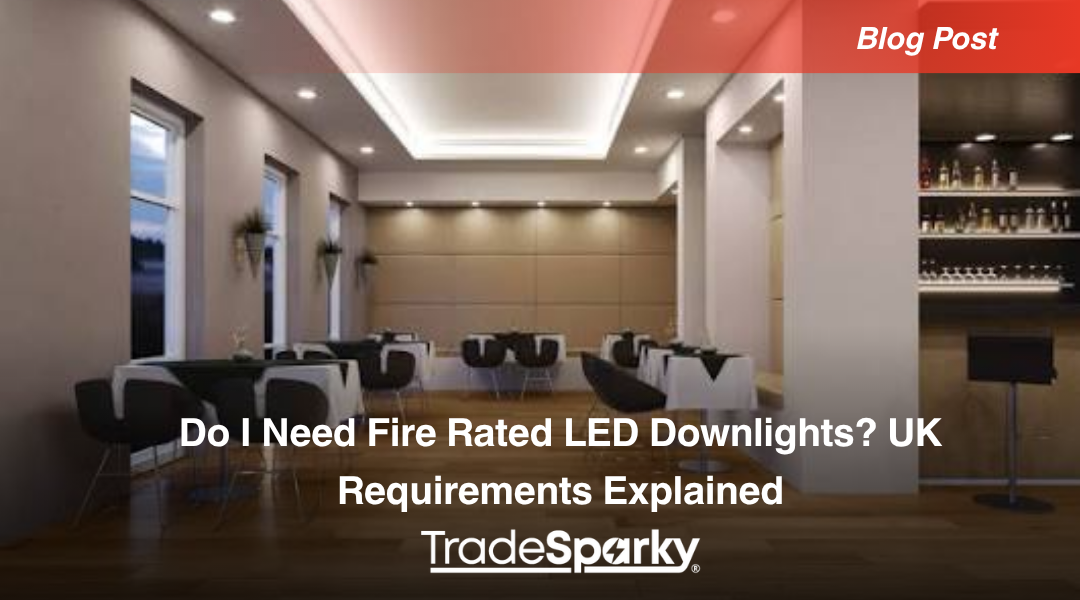
Installing a recessed downlight involves cutting a hole through the ceiling, and that opening can affect the ceiling’s ability to resist the spread of fire. Fire rated LED downlights are designed to help maintain the fire performance of the ceiling by restricting the passage of fire and heat through the opening.
Whether fire rated fittings are specifically required depends on the construction of the building and the ceiling being penetrated. However, fire rated fittings are widely recommended for recessed installations, making fire performance an important consideration when choosing LED downlights for a new installation or refurbishment.
What Is A Fire Rated LED Downlight?
A fire rated LED downlight is a recessed fitting that has been tested as part of a fire-resistant ceiling construction.
Many designs incorporate intumescent material. When exposed to high temperatures, this material expands and helps seal the opening created for the downlight, slowing the movement of fire and heat into the ceiling void.
This is particularly important because an otherwise fire-resistant plasterboard ceiling can be compromised when openings are cut into it for recessed lighting.
Do All LED Downlights Need To Be Fire Rated?
There is not a simple rule stating that every downlight installed in every ceiling must have exactly the same fire rating.
The requirement depends on the role that the ceiling plays within the building. Where the ceiling forms part of a fire-resisting floor or compartment, any penetrations should not undermine the required level of fire resistance.
Electrical Safety First recommends using downlights with integral fire protection wherever possible where the ceiling lining provides fire protection to the cavity above.
In practice, choosing fire rated fittings can also simplify product selection because they provide documented fire performance for suitable ceiling constructions.
What Do 30 60 And 90 Minute Fire Ratings Mean?
Fire rated downlights are commonly available with ratings such as 30, 60 and 90 minutes.
These figures relate to the period of fire resistance achieved by the tested ceiling construction containing the fitting. They should not be interpreted as the downlight independently surviving a fire for a stated number of minutes.
Different buildings and floor constructions can require different levels of fire resistance.
For example, some domestic floor constructions may require 30 minutes, while compartment floors in larger or taller residential buildings may require 60 or 90 minutes or more.
The important point is to select a fitting that has suitable test evidence for the ceiling construction in which it will actually be installed.
Is A 90 Minute Downlight Automatically Suitable For 30 Minutes?
Not necessarily.
It might seem logical that a fitting achieving a 90-minute test must automatically be acceptable in a 30-minute ceiling, but fire testing does not work quite that simply.
Ceiling constructions used for different tests can vary in plasterboard thickness, joist type, joist spacing and other details. A product should therefore have evidence confirming its suitability for the specific construction and fire resistance period required.
This is why good quality fire rated fittings often list several separately tested ratings rather than simply displaying the highest number.
Does Joist Type Matter?
Yes. Modern buildings can use traditional solid timber joists, engineered I-joists or metal-web joists, and these constructions do not necessarily behave identically during a fire.
When specifying fire rated LED downlights, check the manufacturer's test information to establish which ceiling and joist constructions are covered.
This can be particularly important in newer properties where engineered floor systems are common.
Does Fire Rated Mean Insulation Coverable?
No. These are two different characteristics.
A fire rating relates to maintaining the fire performance of the ceiling construction. An insulation-coverable rating tells you whether thermal insulation can safely be placed over or around the fitting.
Never assume that a fire rated downlight can automatically be covered with insulation. Check the manufacturer's installation instructions and specified clearances.
Fitting depth and construction should also be considered when planning the installation. Our guide to integrated LED downlights vs GU10 fittings explains some of the differences between the two main approaches.
What About Fire Rated Downlights In Bathrooms?
Fire resistance and moisture protection are also separate issues.
A downlight can be fire rated without having the correct IP rating for a particular bathroom location. Where lighting is installed around baths, showers or other wet areas, the appropriate level of ingress protection must also be considered.
Our guide to bathroom LED downlights and IP ratings explains this separately.
Choosing The Right Fire Rated LED Downlight
Start by establishing whether the ceiling has a required fire resistance and what type of construction is being penetrated. Then check that the chosen downlight has suitable test evidence for that application.
You should also consider lumen output, colour temperature, beam angle, dimming compatibility, fitting depth and whether insulation may be present above the ceiling.
Fire rating is therefore not simply an additional feature printed on the box. It forms part of choosing a downlight that is appropriate for the construction in which it will be installed, helping preserve the protection the ceiling was designed to provide.







































 Cable & Cable Installations
 Lighting & Lamps
 Wiring Accessories
 Cable Accessories
 Power Distribution
 Heat & Vent
 Energy Controls
 Fire & Security
 Tools & Fixings
 Test Equipment
 Site Equipment & Lighting
 EV Charging
 Solar
Solar


.png)